

Corporate academies are being redefined beyond their traditional role as training units that develop employees' knowledge and skills, evolving into learning ecosystems directly aligned with an organization's strategic priorities, competency needs, and transformation goals.
In this transformation, learning engineering offers a holistic approach that enables corporate learning activities to be designed in a more systematic, evidence-based, and measurable manner. By integrating learning sciences, data analytics, educational technologies, and human-centered design principles, this approach focuses not only on the delivery of training programs but also on examining the conditions under which learning occurs, how learning translates into behavioral change, and the extent to which it contributes to business outcomes.
A corporate academy that adopts a learning engineering approach:
- Aligns learning needs with the organization's strategic objectives.
- Defines target competencies clearly and measurably.
- Develops learning pathways tailored to employees' diverse needs.
- Leverages technology and data to enhance the learning experience.
- Monitors the relationship between learning outcomes, performance, and business results.
- Establishes continuous improvement mechanisms based on feedback and evaluation results.
From this perspective, a corporate academy evolves from a unit responsible for managing training activities into a strategic structure that enhances organizational learning capacity, strengthens the talent ecosystem, and supports organizational transformation.

Prof. Dr. Kürşat Çağıltay – Dean of the Faculty of Education, TED University
IEEE Türkiye Professional Development and Education Coordinator
Arzu Hancı Karademirci – Director of the Continuing Education and Development Center (SEM)
This content is excerpted from the article titled "Transforming Corporate Training: Learning Engineering." You can access the full article here.
Business Outcomes, Evidence, and Accountability
From a global perspective, corporate learning and development is no longer merely a support function but a strategic area of investment.
Josh Bersin (2024) reports that the global corporate training industry has grown to exceed $340 billion, with companies investing an average of $1,500 per employee annually. Similarly, The Business Research Company (2025) projects that the global corporate training market will reach $417.43 billion in 2025.
These figures clearly demonstrate that organizations are investing more in learning than ever before. However, as the scale of investment increases, the focus inevitably shifts beyond how much training is delivered to more fundamental questions: What problems does this training solve? What impact does it create? And how can that impact be demonstrated through evidence?
In other words, the challenge in corporate training is no longer about "doing more," but about designing learning initiatives intentionally, systematically, and based on evidence. The critical turning point lies in how clearly training activities are connected to performance, behavioral change, and business outcomes.
This is where learning engineering emerges as a holistic approach aimed at translating growing investments into meaningful results. To fully understand this approach, learning engineering must be recognized and examined not as a passing trend or buzzword, but as a contemporary discipline with clearly defined boundaries, claims, and areas of responsibility.
Why Must Corporate Training Evolve Toward Learning Engineering?
Research indicates that learning and competency development programs in many organizations are not systematically aligned with business outcomes, limiting their impact on behavioral change and performance. For example, analyses published by McKinsey & Company reveal that a significant proportion of organizations are unable to consistently track the contribution of training investments to business performance through regular, measurable indicators. This makes it difficult for learning programs to generate sustainable impact (McKinsey & Company, 2015; 2018).
Similarly, Boston Consulting Group's analyses of people management highlight the need for more systematic measurement, feedback, and continuous improvement mechanisms to connect talent management strategies with business outcomes (Boston Consulting Group, 2021). In this context, the fundamental issue is not simply whether organizations provide training, but rather how individuals and organizations learn, under what conditions learning occurs, and whether that learning translates into effective decision-making across different contexts. While traditional Learning and Development (L&D) models primarily focus on content production, program reach, and participation metrics, learning engineering approaches learning as a system that is designed, tested, and continuously improved based on evidence (Goodell, 2022). This systems approach directly connects individual learning experiences with the development of organizational capabilities.
Therefore, learning engineering is not merely an "option for advancement" in corporate training. Rather, it represents a direction of transformation that naturally emerges from increasing investment pressures, expectations for measurable impact, and the growing need for organizational learning (Bersin, 2024). For organizations, the question is no longer "Should we transition to learning engineering?" but rather "How quickly, through what approach, and at what level of maturity should we make this transition?"
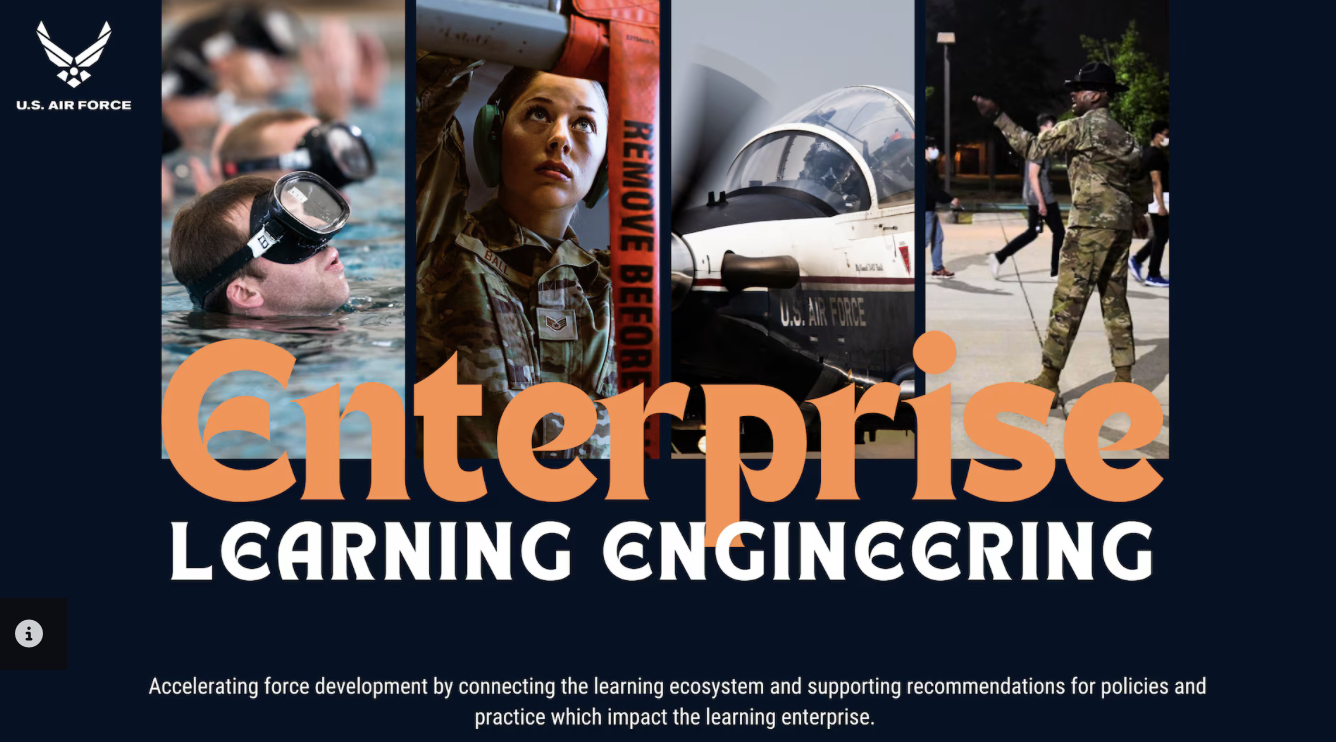
Learning engineering is not limited to the design of individual courses or learning experiences. This approach also enables institutions to structure their programs, technological infrastructures, data systems, competency models, and professional development activities within an integrated learning ecosystem.
The Enterprise Learning Engineering Center of Excellence model, developed by the U.S. Air Education and Training Command, provides a contemporary example of how learning engineering can be implemented at an institutional scale. The center's areas of focus include testing learning technologies, developing interdisciplinary training models, supporting instructor professional development, managing learning data, establishing competency-based frameworks, and strengthening collaboration between academia and industry.
This example demonstrates how learning engineering can be integrated with institutional missions, organizational capacity, and sustainable development.
Applying learning engineering to corporate training processes involves more than simply developing new training content. The process requires a comprehensive assessment of organizational needs, target competencies, existing learning technologies, available resources, and performance expectations.
Content published by the Association for Talent Development (ATD) presents a six-stage framework for implementing learning engineering in corporate and government training contexts:
- Identifying competency needs
- Developing competency models
- Reviewing existing technologies and resources
- Designing the learning framework
- Developing implementation recommendations
- Evaluation and personalization
This framework enables corporate academies to align their learning activities with organizational objectives and develop more systematic, learner-centered, and measurable learning systems.
Learning Engineering: What Is It and How Can the Government Benefit?
Contemporary learning engineering practices emphasize human-centered design, interdisciplinary collaboration, competency-based learning, and evidence-based decision-making. This approach evaluates learning activities not merely in terms of content delivery or participation rates, but also in terms of how learning translates into behavioral change, performance improvement, and organizational capacity.
The article "Learning Engineering in Focus Today," published by the U.S. Air Education and Training Command, explores a systems approach to learning environments, emphasizing the integration of technology, data, human performance, and expertise from various disciplines to achieve shared learning objectives.
The panel discussion explores how learning engineering can be implemented in operational and institutional settings, addressing the relationship between human-centered design and organizational objectives, competency-based learning, evidence-based decision-making, and interdisciplinary collaboration.
Featuring contributions from experts representing various government agencies and service branches, the session provides examples of how learning engineering can serve as a framework for transformation in large and complex organizations.
Implementing Learning Engineering in Military Environments: An Operational & Tactical Perspective