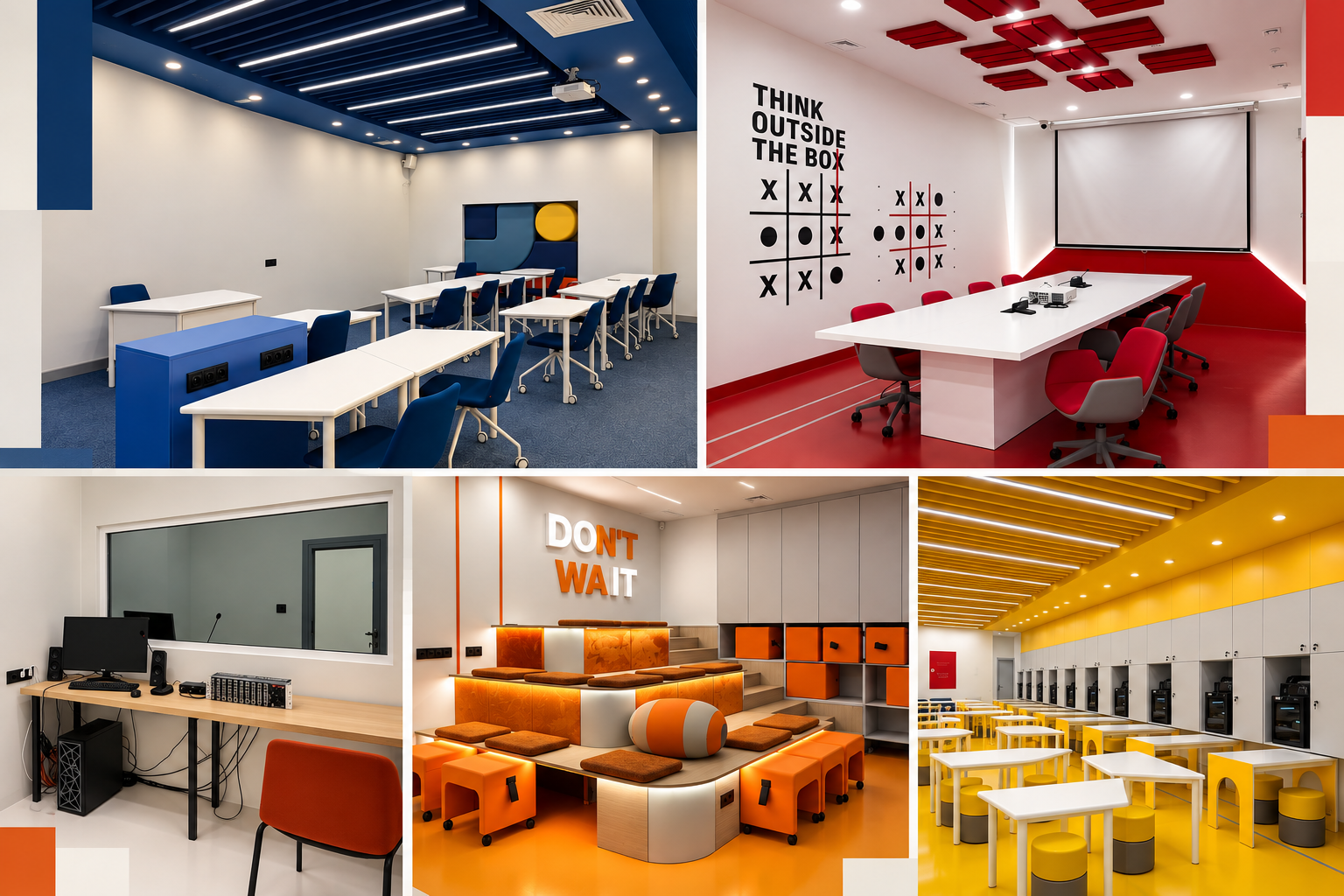
The Center of Excellence in Education, established within the Faculty of Education at TED University, aims to accelerate digital transformation in education, promote innovative teaching approaches, and create a pioneering environment that brings together research, practice, and development in the field of educational technology. The Center seeks to prepare pre-service teachers, academics, researchers, and other educational stakeholders for the evolving learning ecosystem, encourage interdisciplinary collaboration, and contribute to the exchange of knowledge and experience at national and international levels. In this regard, one of the Center's key priorities is to support the integration of emerging technologies, including artificial intelligence (AI), augmented and virtual reality (AR/VR), learning analytics, eye-tracking, wearable technologies, and gamification, into educational processes based on scientific evidence and pedagogical principles.
The Center aims to establish an ecosystem that supports technology integration in education through both research and practice. Within this framework, the Center focuses on developing research and development (R&D) projects related to innovative teaching practices and conducting research and practical applications on the use of emerging technologies in teaching and learning environments through its Human-Computer Interaction Laboratory. In addition, the Center provides consultancy and support to academics on digital course design and technology integration. It also works on organizing training programs, workshops, and certificate programs for pre-service teachers, in-service teachers, and educational administrators in areas such as digital pedagogy, artificial intelligence, learning analytics, and AR/VR. Furthermore, the Center aims to contribute to the educational ecosystem by developing open educational resources, digital learning materials, and innovative instructional content.
In the long term, the Center aims to establish strong collaborations with international universities, technology companies, and educational organizations, conduct joint research projects, and support not only knowledge production but also the development of innovative educational technologies and products. Its key objectives include connecting research outcomes with the entrepreneurial ecosystem, developing sustainable solutions in educational technology, and creating opportunities for interdisciplinary collaboration across the university. In line with this vision, the Center seeks to serve as a strategic research and practice hub that strengthens TED University's leadership in educational innovation and learning technologies while creating an impact at both national and international levels.
The Center also conducts in-house research and development (R&D) activities focused on developing original educational software solutions. One example is the SAGE project (Design, Development, and Evaluation of an Editor for Teachers to Create Virtual Reality Environments), supported by TÜBİTAK under the 1001 Research Program (Project No. 223K485). The project focuses on developing an innovative software platform that enables teachers to design their own virtual reality (VR)-based learning environments without requiring advanced technical knowledge or programming skills. The cloud-based and mobile-compatible platform is designed to facilitate the development of interactive learning materials through features such as Turkish language support and integration with learning management systems. This project demonstrates the Center's efforts to develop customized technological solutions that address educational needs, translate research findings into practical applications, and strengthen its in-house educational software development capacity.
Project website: https://sagemo.tr
Research Infrastructure and Technological Facilities
Human-Computer Interaction Laboratory
The Center has established a laboratory equipped with advanced technological infrastructure to support research in Human-Computer Interaction (HCI). The laboratory includes an observation room with a one-way mirror, allowing researchers to observe participants in naturalistic settings, as well as advanced audio and video recording systems. It is also equipped with one Tobii Pro Glasses 2, one Tobii Pro Glasses 3, and a desktop eye-tracking device. These technologies are used in research investigating user behavior, visual attention processes, and learning experiences.
Wearable Technologies
The Center provides a range of electronic components and materials to support educational and research activities involving wearable technologies. These resources are used by both students and researchers to design, develop, and evaluate wearable technology applications.
3D Printing
The Center is equipped with 10 3D printers that support educational activities and instructional material development. These printers are used to help pre-service teachers learn three-dimensional design and fabrication technologies and develop physical models and innovative instructional materials to support the teaching of various concepts. The training and practical activities conducted in this area are not limited to pre-service teachers but also include in-service teachers. Through these activities, the Center supports teachers in effectively integrating 3D printing technologies into their teaching practices.
Virtual Reality Technologies
The Center is also equipped with Meta Quest headsets and basic VR glasses to support educational applications involving virtual reality (VR). These technologies are used to conduct research on teaching and learning processes, develop interactive digital learning materials, and implement innovative instructional practices in classrooms. Through these technologies, students, teachers, and researchers have opportunities to experience, design, and evaluate immersive learning environments.